Saturday, July 17, 2010

Springfield, USA and Springfield, Australia

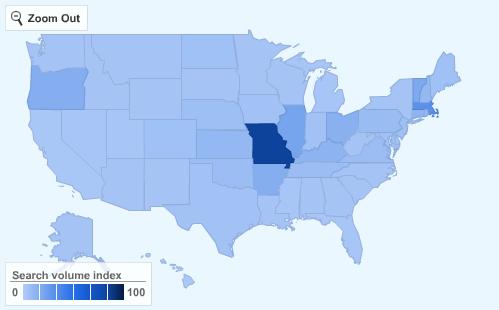
So I've heard that Matt Groening decided to name the fictitious city where the Simpsons live "Springfield" because there's one in almost every state. Turns out that's quite accurate - and, laughably, there are five Springfields in Wisconsin alone. The map of where in the USA people are Googling "Springfield" looks like this:


Certainly an atypical map. What's going on? Well, here's a list of the top ten states, and the population of the community within their borders called "Springfield":

  1. Missouri (157,630. Metro: 430,900)
  2. Massachusetts (154,082. Metro: 680,014)
  3. Illinois (116,909. Metro: 201,437)
  4. Vermont (9,078)
  5. District of Columbia (None)
  6. Oregon (52,864)
  7. Arkansas (No Wikipedia page, but it exists)
  8. Ohio (65,358. Metro: 140,477)
  9. Connecticut (None, but Sprinfield, MA borders it)
  10. Kentucky (2,634)
Okay, that didn't make a lick of sense, did it? Here's the same thing for Australia:


  1. Queensland (5,732)
  2. New South Wales (3,921)
  3. Northern Territory (None)
  4. ACT (None)
  5. Victoria (There are two, but no population listed for either)
  6. South Australia (541)
  7. Tasmania (There is one, but no population listed)
  8. Western Australia (None)
 Okay, that made even less sense. I'll just stop now.

Enhanced by Zemanta

Saturday, July 10, 2010

American States: second most popular sport

So I tried the Google Insights / Inkscape trick again to make another map. I would have liked to make a map showing which sport is most popular (where 'most popular' means 'most Googled' in which state, but that would have been pretty boring: a single-coloured map in which 'football' is most popular in all fifty states. Without exception.

Of course, this being the USA, 'football' refers not to the sport of the World Cup but the one of the Super Bowl. Or at least in theory it does: who can tell what people are actually looking for when they type 'football' into Google's search engine.

Anyway... removing football from the list and replacing it with the other big sports - baseball, basketball, hockey and soccer (yes the other football) - suddenly presents an intriguing map:


It's an odd one. The only one it's easy to say much about is hockey: the sport thrives in northern states, along the Canadian border. None of the states coloured blue here has an NHL franchise, but with the exception of the Green Bay Packers neither do they have a franchise in any of the other main professional team sports. Washington State uniquely prefers soccer, something not easy to explain. You might chalk it up to Washington's large immigrant community, but certainly a good many states here have high immigrant populations.

Now... baseball vs. basketball? It's tough to see what's happening here. The South and the Northeast seem to prefer baseball, but why? And why is the heartland so basketball-happy?

I can only make a stab at an answer. The populous states, containing big cities, seem to prefer baseball: California, Texas, Florida, Illinois, New York. Perhaps states with successful baseball franchises get the interest in baseball, whereas states with no MLB team gravitate to basketball. Why? Well, like American football, basketball is also a college sport, and the NCAA competes for attention with the NBA. Perhaps it's the college level, something baseball doesn't really have, that pushes it ahead.

Enhanced by Zemanta

Saturday, July 3, 2010

American States: big cities

I've done up two maps of the USA, using Inkspace and Google Insights. The first one, this one, was perhaps better in concept than in execution. But oh well. Anyway, what I did was to take five 'regional hub' cities, New York, Chicago, Atlanta, Houston and Los Angeles, and see in each of the 50 states which of the five was Googled most often. I expected to find obvious results in New York State, Illinois, Georgia, Texas and California, but it was the other 45 states I was curious about. The results:


The principle was right: there are 'regions' in the States where people gravitate towards certain big cities - if for no other reason than because they're following the nearest big sports team. So in particular there's a three-state 'zone' (or 'tristate' as they say there) around Houston and around Atlanta. What surprised me was not the fact that New York appears to be the 'default' (among other things, it is of course also the name of a state) but (1) that outside of California itself there is no state where Los Angeles is Googled more often than the others on this list and (2) Chicago has a huge 'zone' of eleven states, extending as far away as Wyoming. Intriguing, and not something I can entirely explain. What has people in Wyoming more interested in Googling Chicago than any other of these cities?
Enhanced by Zemanta

Saturday, June 19, 2010

Vuvuzelas


Always be able to find the South African World Cup in an instant or less... This graph is dynamic, and will change with time. But you'll always be able to find June 2010 on it: just look for that massive spike, when the global soccer championship added a new word to the vocabularies of the people of the world: vuvuzela.

For someone like me who doesn't follow sport, it's the stuff around the football that intrigues me about the World Cup. A vuvuzela is a kind of horn that is popular in South Africa and, without exception, reviled in every other country of the planet. I would have guessed that people were Googling it to discover how to avoid being driven mad by it. But it turns out that what people are interested in includes: "vuvuzela mp3", "youtube vuvuzela", "buy vuvuzela", "vuvuzela acheter", "vuvuzela kaufen". But "vuvuzela ban" is also there, so who knows?

In any case, no surprise that it's South Africa Googling it the most. The rest of the top ten is entirely in Europe, though. Maybe they can hear it from there.

Enhanced by Zemanta

Saturday, June 12, 2010

Siamese Twins #2

More Siamese Twins. You might want to read last week's entry to understand the concept. But here's a handful more two-word phrases that stick together like glue.


Obviously 'hammer' is going to be Googled more often than 'sickle' - now that the USSR is dead, the only time you ever hear 'sickle' is in connection with anaemia. It is the USA where sickle is Googled the most.


Excluding lightning, 'bolts' are only one thing, where 'nuts' are rather more. I doubt that construction equipment is even the prime reason why 'nuts' are Googled, when there's foodstuffs to be had.


And speaking of lightning... it turns out thunder tends to be Googled more often than lightning, and for one stretch there, much more. Interesting that there is a professional NHL team called Lightning, and an NBA team called Thunder (which I'd never heard of before now).


Although 'puff' kills 'huff' everywhere in the world, the difference is (by far) least pronounced in the USA. The legacy of the Huffington Post?


Suppose its the music- and drug-saturated all-night party that puts 'rave' so far ahead of 'rant'? Well, 'rave' is most Googled in the US, where I was expecting a European country. But what do I know?


Reblog this post [with Zemanta]

Saturday, June 5, 2010

Siamese Twins #1

Siamese twins. No, not Chang and Eng. It's a grammatical concept to describe couplets like 'spic and span'. Together, they mean 'clean', but only together. You can't say, "this floor is spic, but I don't think it's span enough." You can't say 'span and spic' either. They're fixed.

So which is Googled more?


In the case of 'spic and span', no surprise, since 'span' is a useful word by itself, and 'spic' is just a racial slur. Except in Macedonia, where it is hugely Googled, and presumably means something else.


Heaven and hell: fascinating, this one, and probably worth its own column. Heaven beats hell, but not by much. And the odd thing is that the gap is narrowing: recently, hell has surpassed heaven. The countries biggest on heaven are the Philippines, the UK and Australia, but people in New Zealand and the Czech Republic Google hell more than heaven.


I'm not sure that 'cranny' means anything at all, separated from 'nook'. And 'nook' isn't the most meaningful word either - at least not till recently. That huge spike is the result of Barnes & Noble launching something I can't be bothered to learn about called 'Nook'.


Now that's a beautiful graph. And I didn't expect to find these two words so closely linked: after all, 'pros' also means 'professionals', and 'cons' also means 'convicts' (and why has no-one ever made a TV show about those two groups of people and called it 'Pros & Cons'?). But they are clearly linked, on a delightfully zigzaggy graph that appears to be diverging ever so slightly.


For reasons that might not be 100% noble, the ladies leave the gentlemen completely in the dust. The nations that have Googled 'ladies' most (Ethiopia leads the pack) haven't Googled 'gentlemen' at all.


With court cases being popular reading material, but the internet being based on infamously buggy computers, I wasn't sure whether 'trial' or 'error' would be Googled more, but in retrospect it's obvious: computer error messages are one of the few truly practical uses for Google. It's in India where those computers screw up most.


Reblog this post [with Zemanta]

Saturday, May 29, 2010

Warner Bros. Cartoon Characters

So of course in the great cartoon wars that exist only in my mind, the Disney stable would square off against the Warner Bros. team, with Hanna Barbera and whoever else mere bystanders. And, of course, Warner Bros. would win, with pluckier and more individual characters, with a sharper sense of humour and of surreal whimsy.

Just as Mickey Mouse is the jewel in the Disney crown, Bugs Bunny is the sun around which the other characters, like so many planets, orbit. So when I decided to look at five Warner Bros. characters, and how much they've been Googled, I went into it expecting Bugs Bunny would be the most Googled. I don't think I realised by how much, though.


That's a huge difference. What intrigues me, though, is where these characters are most Googled. Here's the top five for each:

  • Bugs Bunny: Turkey, Philippines, Canada, Peru, Greece. A more random list I could not imagine. Apart from Turkey and Greece being neighbours, the countries on this list are nowhere near each other. Perhaps each has a city or a major political personage with this name?
  • Daffy Duck: the USA, Australia, Turkey, the UK, Canada. A much more explicable list: with the exception of cartoon fan Turkey, this is primarily the Anglosphere, which brings up the question of what these characters are called in other languages.
  • Porky Pig: United States, Canada, the UK... that's it. Interesting. The Anglosphere, sure, but Porky, the guy who says "that's all, folks" at the end of every Warner Bros. cartoon, doesn't even register on searches outside of these three countries (the rest of the top ten in just countries in alphabetic order).
  • Elmer Fudd: Canada, the United States, Australia, the UK... that's it. Same as Porky, sadly - except the Australians show up.
  • Speedy Gonzales: Italy, Germany, the Netherlands, the United States, Canada. And now for something completely different. I don't know whether or not I was surprised to find Mexico absent from the top ten, but the sudden preponderence of European countries threw me for a loop.
Here's a few translations, according to Wikipedia:
  • English, German, Spanish, French, Bahasa Indonesia, Itlain, Swahili, Dutch, Portuguese, Romanian, Turkish: Bugs Bunny.
  • Serbian: Duško Dugouško.
  • Danish: Snurre Snup.
  • Croatian: Zekoslava Mrkva.
  • Norwegian: Snurre Sprett.
  • Polish: Królik Bugs.
  • Finnish: Väiski Vemmelsääri, or apparently Pelle Pupu.
 
Reblog this post [with Zemanta]